Pages

With the "Pages" tool, you can create a mini online shop in no time, allowing you to sell your products and services – without any programming knowledge or the need for your own website.

The Payrexx "Pages" tool is ideal for small businesses and private individuals, as it enables you to create your own online shop within minutes, meeting the highest security standards and allowing your customers to pay using all common payment methods.

Features

  • ✅ Multiple products/services including variants

  • ✅ Charging shipping costs

  • ✅ Inventory management

  • ✅ Order and payment confirmation emails

  • ✅ Granting discounts

  • ✅ Search engine optimization (SEO)

  • ✅ URL parameters

  • ✅ Website integration

  • ❌ Mixed shopping carts

  • ❌ Upselling

  • ❌ Merchant API endpoint

You do not need your own website or any technical knowledge to set it up. In the next section, you will learn just how easy it is.

Creating a Shop

The following instructions will help you create your own online shop using the "Pages" tool:

  • Log in to the merchant administration of your Payrexx account.

  • Navigate to Pages > Overview.

  • Click "Create" in the top right corner:

Creating a new shop in the "Pages" tool

After you click "Create", the edit mode of the Pages shop opens. The settings you can configure in your shop are divided into the following five tabs:

The configuration of the shop is divided into these five areas.
In the following five sections, you will learn more about each area:

circle-info

The content of your shop can be entered in multiple languages. For more information, see the article on the multilingual frontendarrow-up-right.

Title and description

In the first tab, you can configure the following settings:

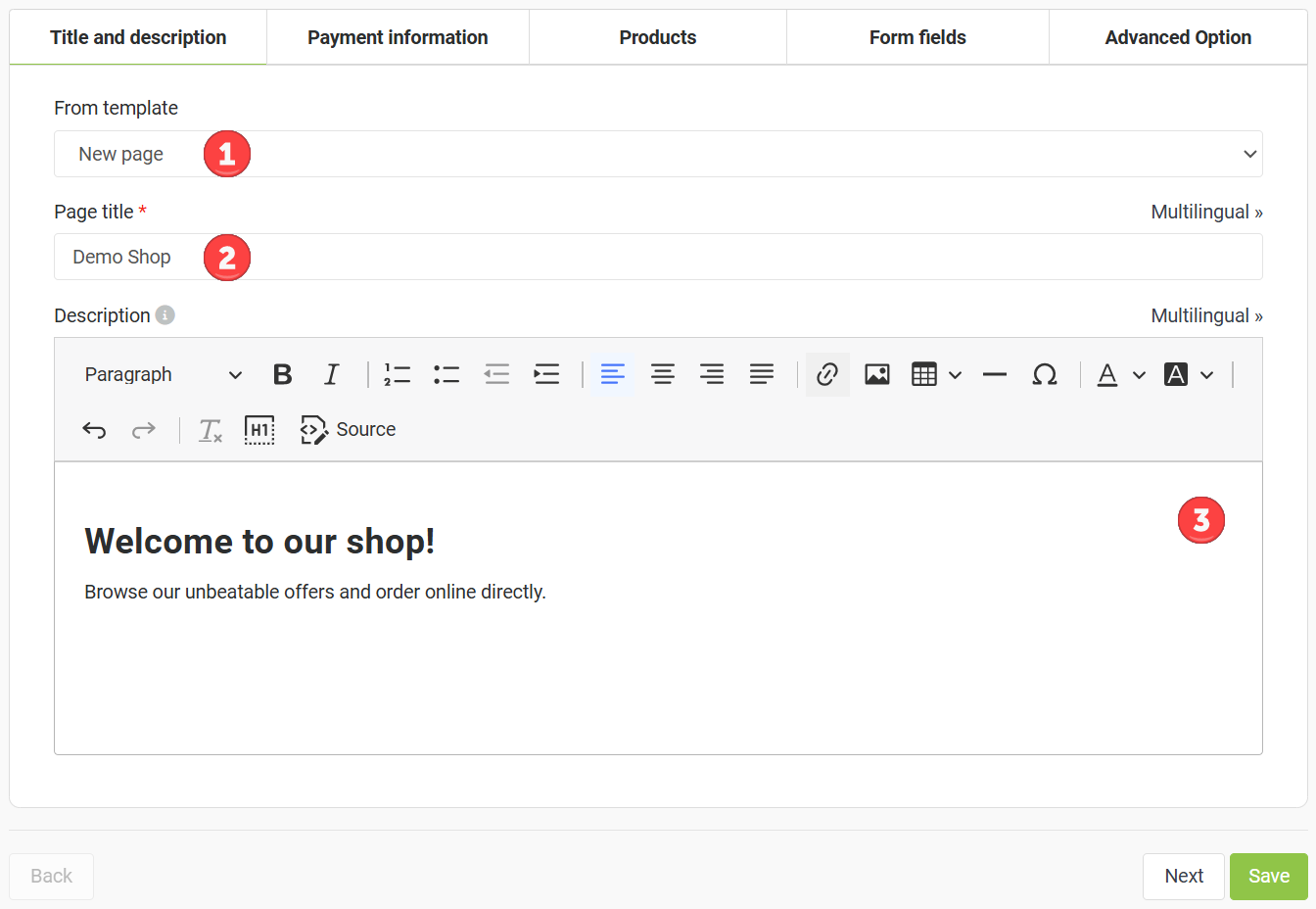
Creating a shop with the "Pages" tool: Tab 1/5 – Title and description
  1. From template: If you have previously created shops using the "Pages" tool, they will appear in this selection field. You can choose to use an existing shop as a template, in which case the new shop will be created based on the data and settings of the existing shop. Selecting the "New page" option will create a blank shop that you can configure from scratch.

  2. Page title: Enter a title for your shop. It will be displayed at the top of the shop page as an H1 title and will also serve as the meta title of your shop.

  3. Description: Optionally, enter a description text. It will be displayed on the shop page between the title and the product listing. In addition to plain text, you can also use HTML elements and images in the description.

Payment information

In this tab, you can configure payment settings, define currencies, and select payment providers:

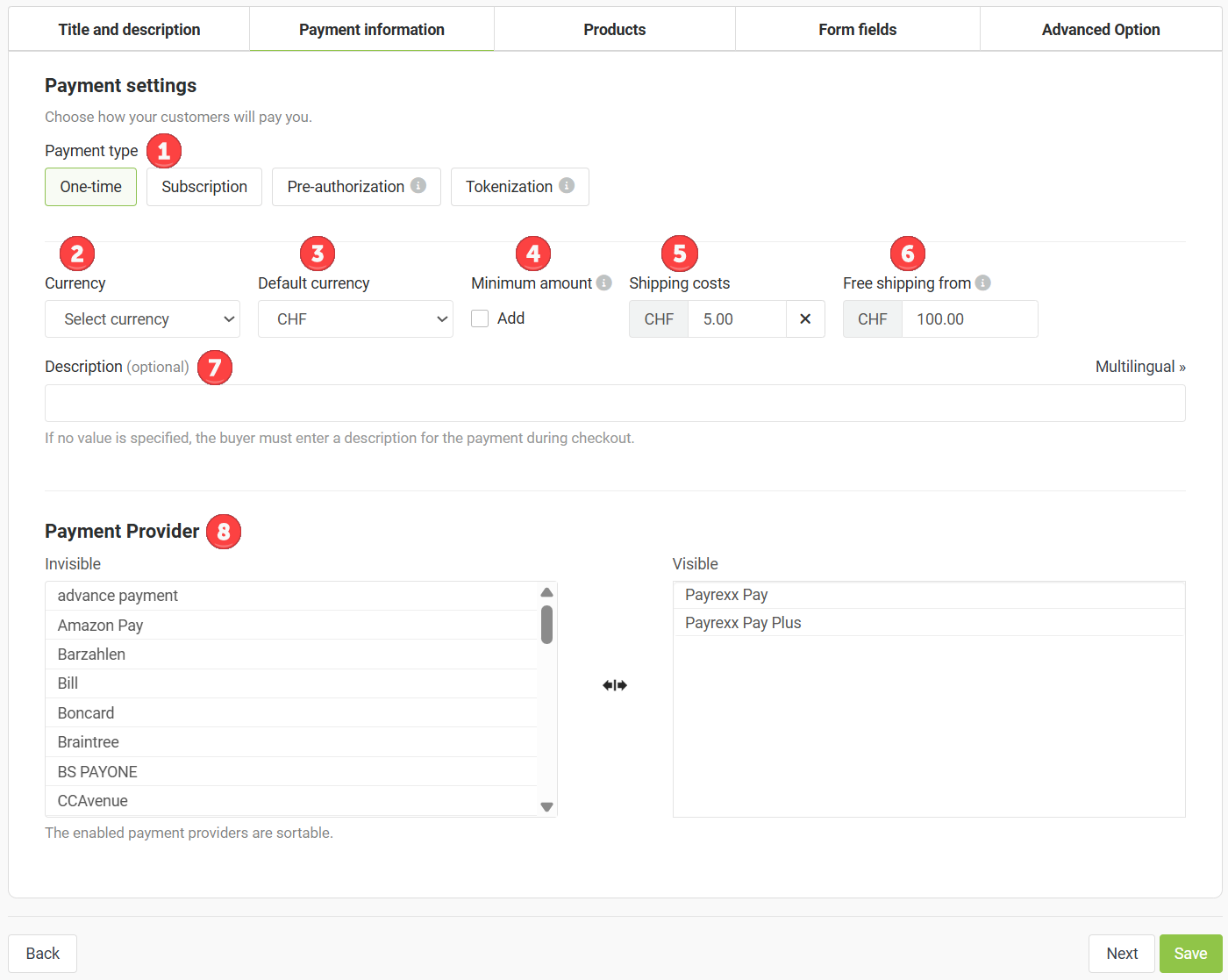
Creating a shop with the "Pages" tool: Tab 2/5 – Payment information
  1. Payment type: Specify which type of payments you want to accept in your shop. You can choose between one-time payments, subscriptions, pre-authorizations, and tokenizations.

circle-exclamation
  1. Currency: Enable a specific currency or choose "Select currency" so that the customer can choose the currency in which they want to pay.

circle-info

If your desired currency is not available, please check the configuration of your payment providers and enable the corresponding currency there.

  1. Default currency: If you activated the "Select currency" option, you can define which currency should be displayed by default.

  2. Minimum amount: Click "Add" if you want to set a minimum payment amount. Customers will not be able to make a payment below this defined minimum.

  3. Shipping costs: Optionally, specify an amount for shipping costs.

  4. Free shipping from: Optionally, define a cart value from which no shipping costs will be charged.

circle-exclamation
  1. Purpose: Enter a purpose or leave the field empty so the customer can specify one themselves.

  2. Payment providers: Select which payment providers customers can use to pay in your shop. You can change the order of the payment providers by clicking and dragging.

Products

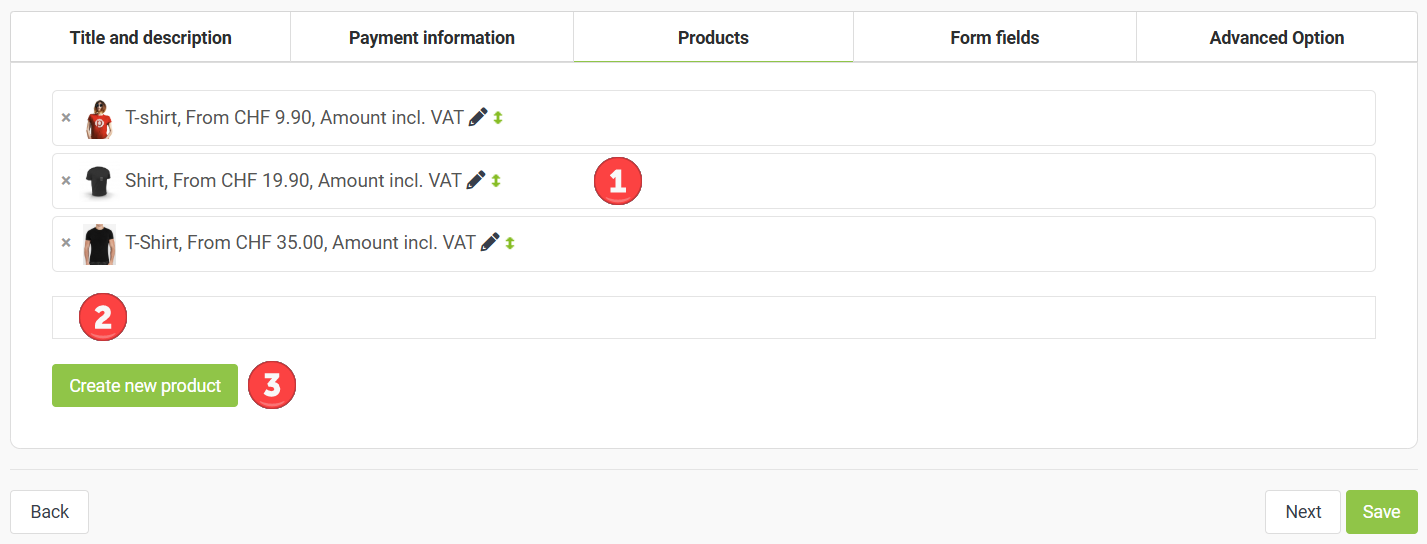
In this tab, you can manage the products in your shop:

Creating a shop with the "Pages" tool: Tab 3/5 – Products
Form fields

In this tab, you can specify which information you want to collect from your customers during the checkout process:

circle-info

We recommend requesting at least the email address to be able to identify the customer clearly at a later stage.

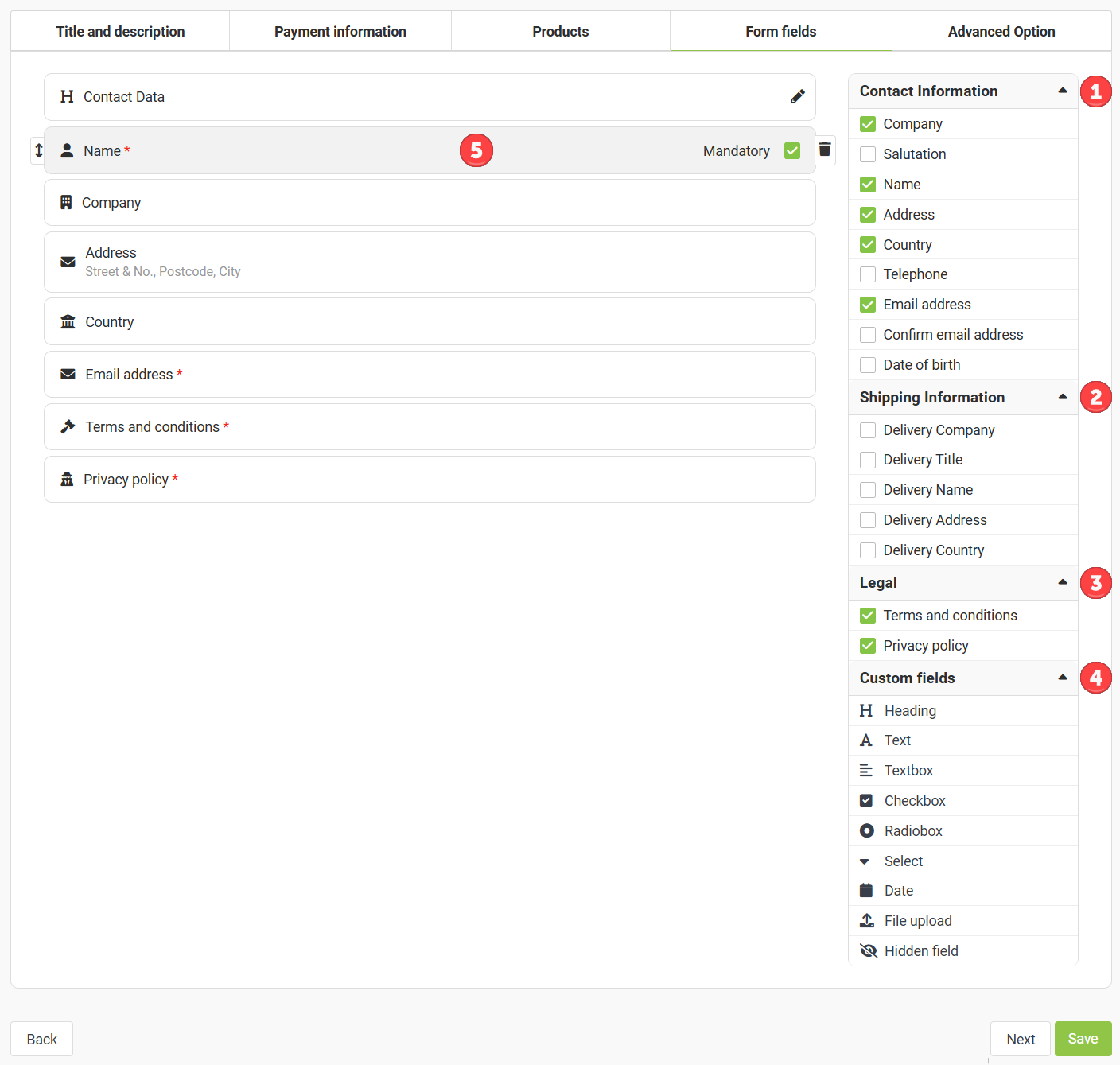
Creating a shop with the "Pages" tool: Tab 4/5 – form fields

On the right-hand side of the screen, all the fields that you can add to the order form on your shop page are listed. Check the box next to the fields you want to include.

The fields are grouped as follows:

  1. Contact information: Salutation, name, address, contact details, and date of birth of the customer

  2. Shipping information: Information for the customer’s delivery address

  3. Legal: Terms and conditions and privacy policy (these fields are mandatory by default)

  4. Custom fields: You can optionally add additional fields to the form by selecting the desired field type

  5. Editing fields: When you hover over a field, the following options appear:

    1. The icon allows you to reorder the fields.

    2. Checking the “Required Field” box makes it mandatory for the customer to complete the field in order to submit the order.

    3. Clicking the icon deletes the corresponding field.

circle-info

Please note that TWINT does not require customer information. If you accept TWINT payments, we recommend collecting the necessary customer data by enabling the corresponding form fields so that you can assign payments to the correct customers.

Including form fields in the export

Fields under "Contact information", "Shipping information", and "Legal" are included in the transaction export by default.

Custom fields, except for the heading, can also be included in the export. To do so, the "Include in Export" checkbox must be enabled for each respective field.
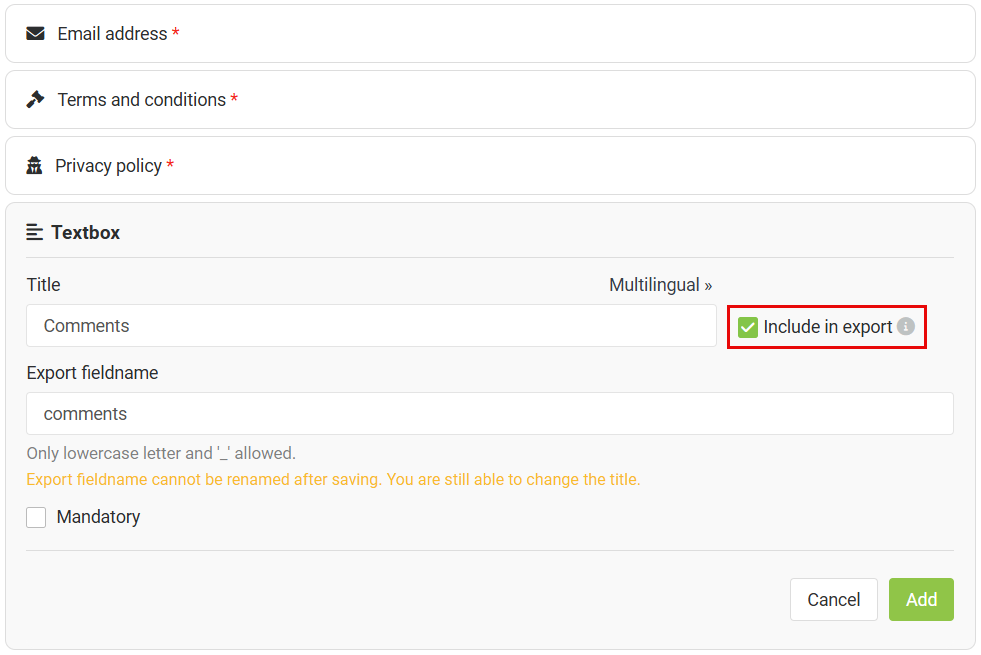
Including a field in the transaction export: Example with the "Comments" field

Advanced options

The final tab includes various settings for the shop’s appearance, messages, and redirects, which are explained in detail below:

[IMAGE]

Legend: Creating a shop with the "Pages" tool: Tab 5/5 – Advanced options
  1. Appearance: Select which Look & Feel profile should be used for the shop’s display.

  2. Text pay button: Choose the label for the call-to-action button.

  3. Discount codes: Optionally add one or more discount codes to offer customers the possibility of a reduced-price purchase.

  4. Message after successful payment: Set a message that will be displayed to the customer on the screen after a successful payment.

  5. Message after failed payment: Set a message that will be displayed to the customer on the screen after a failed payment.

  6. Redirect after successful payment: Add a link to which the customer will be redirected after a successful payment.

  7. Redirect after failed payment: Add a link to which the customer will be redirected after a failed payment.

  8. Message for inactive pages: Set a message that will be displayed to customers if the Pages sales page is inactive.

  9. Email settings: Configure the email sent to customers after a successful payment:

    1. Sender name: This name will be shown to the customer in their inbox as the sender.

    2. Additional recipients: Optionally add additional email addresses besides the customer’s email.

    3. Subject: Enter a subject line for the email.

    4. Additional confirmation message: Any content entered here will be added to the default content of the payment confirmation emailarrow-up-right.

  10. Search Engine Optimization (SEO): Optimize your shop for search engines. For more information, see the following article:

Search Engine Optimizationchevron-right

Managing Shops

In the merchant administration of your Payrexx account, navigate to Pages > Overview to view the list of shop pages.

Finding a specific shop

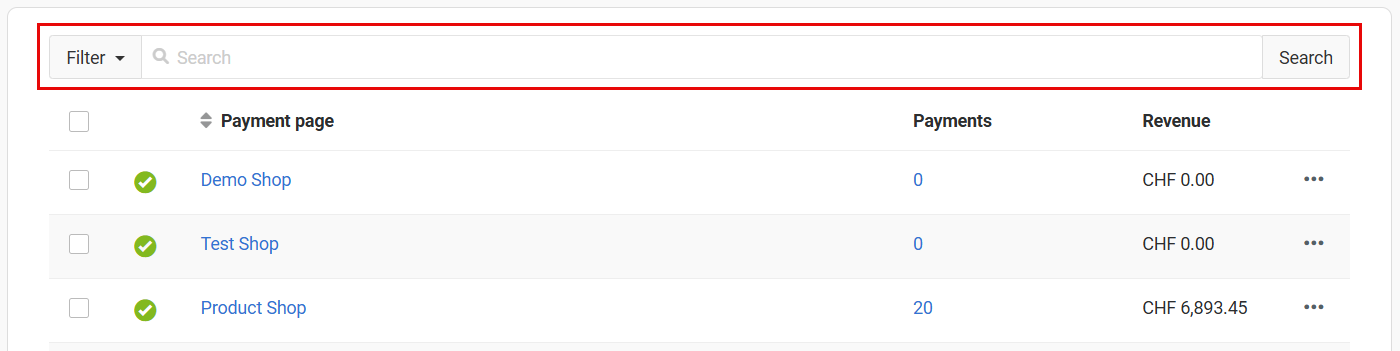
If you are looking for a specific shop, you can use the search and filter functions:

Finding a specific shop using the search and filter functions
  • Filter: Use the filter function to narrow down the list of displayed shops based on their payment type (one-time payments, subscriptions, tokenization, preauthorizations).

  • Search: Use the search field to locate a specific shop by entering a search term (full-text search).

Editing a shop

When you hover over a specific shop on the overview page, the following functions are available:

Functions on the "Pages" tool overview page
  1. Set as default: clicking the "Standard" button makes the shop page the default shop page.

circle-info

When the link https://[instance-name].payrexx.com/ is opened, it will redirect directly to this default shop page.

  1. View: Opens the shop page in view mode, displaying it as your customers would see it.

  2. Integrate: Opens the interface to integrate the shop page into an existing website.

  3. Import discount codes: Opens the interface to import discount codesarrow-up-right into the shop page.

  4. Transactions: Displays the list of all transactions generated through the corresponding shop page.

  5. Edit: Opens the shop page in edit mode.

  6. Copy: Creates a copy of the existing shop page and opens it in edit mode for editing.

  7. Delete: Deletes the shop page.

Additional Functions

Three additional functions are available in the upper part of the window:

Viewing, sharing, and embedding the shop
  1. By clicking on the view icon, you can see how the shop will appear to customers.

  2. Clicking on the share icon allows you to send the shop link. You can also pre-fill the form fields with predefined data.

  3. Clicking on the embed icon lets you integrate the shop into your own website. For more information on this topic, please refer to the following article:

Website Integrationchevron-right

Multilingual support

circle-info

If you are unable to activate multilingual support for your shop, check your basic settings and enable the desired languages there: Settings > General settings > Languages > Enable multilingual frontend

When sharing the link, you can customize it so that your customers are directed to their preferred language version. The encoding follows ISO-639-1.

  • German: https://a.payrexx.com/de/pay?tid=72

  • French: https://a.payrexx.com/fr/pay?tid=72

  • English: https://a.payrexx.com/en/pay?tid=72

In the HTML code, the encoding appears as follows (example for English):

<iframe src="https://example.payrexx.com/en/?tid=2" width="1200" height="500"></iframe>

Last updated

Was this helpful?
