> For the complete documentation index, see [llms.txt](https://docs.payrexx.com/merchant/llms.txt). Markdown versions of documentation pages are available by appending `.md` to page URLs; this page is available as [Markdown](https://docs.payrexx.com/merchant/bezahldienste/payrexx-pay/zahlungsmittel/sepa-debit-direct.md).
# SEPA Debit Direct
In diesem Artikel erfährst Du, wie Du in Payrexx Pay Plus die Zahlungsart SEPA Debit Direct beantragen kannst.
Damit Du die Zahlungsart SEPA Debit Direct innerhalb von [Payrexx Pay Plus](/merchant/bezahldienste/payrexx-pay.md) nutzen kannst, müssen einige Voraussetzungen erfüllt sein. Daher musst Du die Zahlungsart zuerst beantragen. Sobald Dein Antrag geprüft wurde, teilen wir Dir die Entscheidung per E-Mail mit.
{% hint style="warning" %}
SEPA Debit Direct muss separat beantragt werden, da die Zahlungsart aus Sicherheitsgründen nicht automatisiert freigeschaltet werden kann.
{% endhint %}
## Beantragen von SEPA Debit Direct
Die folgenden drei Schritte sind nötig, um die Zahlungsart SEPA Debit Direct zu beantragen:
1. Logge Dich in Dein [Payrexx-Konto](https://login.payrexx.com/de/) ein und navigiere im Hauptmenü zu **Zahlungsanbieter**.
2. Klicke bei Payrexx Pay Plus auf "Konfigurieren":
Konfiguration von Payrexx Pay Plus
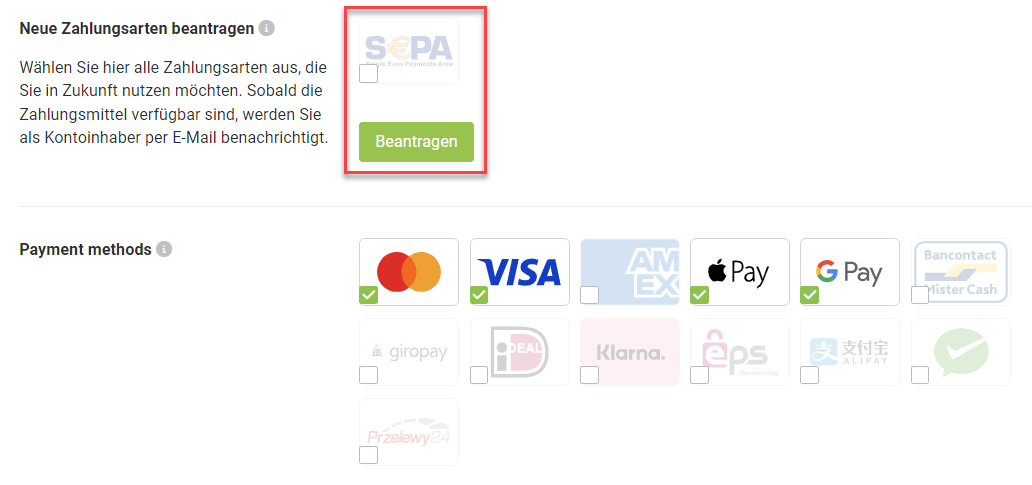
3. Setze das Häkchen unter dem Logo von SEPA und klicke auf die Schaltfläche "Beantragen":
Beantragen der Zahlungsart SEPA Debit Direct in Payrexx Pay Plus
## Prüfung und Entscheid
Dein Antrag wird danach durch das Compliance-Team von Payrexx geprüft. Die Entscheidung teilen wir Dir per E-Mail mit.
## Was bedeutet SEPA?
Der Europäische Zahlungsraum [Single Euro Payments Area (SEPA)](https://de.wikipedia.org/wiki/Europ%C3%A4ischer_Zahlungsraum) ist eine Initiative der Europäischen Union zur Vereinfachung von Zahlungen innerhalb und zwischen den SEPA-Teilnehmerländern. Dabei wurde ein gemeinsamer Bankenstandard implementiert, um Lastschriften für jedes auf EUR lautende Bankkonto innerhalb der SEPA-Region zu ermöglichen.
Zu den SEPA-Teilnehmerländern gehören alle Mitgliedsstaaten der Europäischen Union sowie die Schweiz, Island, Liechtenstein, Norwegen, Albanien, Andorra, die Republik Moldau, Monaco, Montenegro, Nordmazedonien, San Marino, Serbien, Vatikanstadt und das Vereinigte Königreich.
---
# Agent Instructions
This documentation is published with GitBook. GitBook is the documentation platform designed so that both humans and AI agents can read, navigate, and reason over technical content effectively. Learn more at gitbook.com.
## Querying This Documentation
If you need additional information that is not directly available in this page, you can query the documentation by asking a question.
Perform an HTTP GET request on the following URL with the `ask` and `goal` query parameters:
```
GET https://docs.payrexx.com/merchant/bezahldienste/payrexx-pay/zahlungsmittel/sepa-debit-direct.md?ask=&goal=
```
`ask` is the immediate question: it should be specific, self-contained, and written in natural language.
`goal` is what the user is ultimately trying to achieve, the reason they need the answer. Sharing it helps GitBook give you a better, more relevant answer. A goal is most helpful when it describes the outcome the user wants rather than restating the question. For example, with `ask=how do I create an API token`, a goal like `automate deployments from our CI pipeline` lets GitBook tailor the answer to that use case.
The response will contain a direct answer to the question and relevant excerpts and sources from the documentation.
Use this mechanism when the answer is not explicitly present in the current page, you need clarification or additional context, or you want to retrieve related documentation sections.